
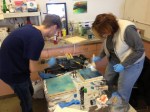
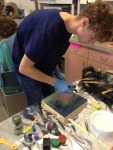
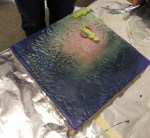
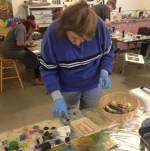

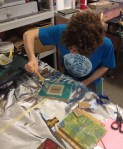
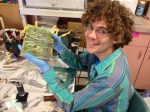


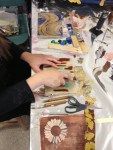

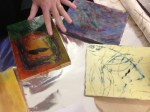
We’re having a relaxing and rejuvinating time over at FAVA, the local arts center in beautiful Oberlin, Ohio! Six local artists have come to play in wax and unwind their minds on six consecutive Saturday afternoons; and while the town rushes around below our second story window, we hide ourselves away, layering warm encaustic wax, fusing with torches; and playing with color, design and texture in our encaustic paintings.
Each artist has forged a path of exporation all their own, with direction and guidance…and lots and lots of mixed media and tools.
Each afternoon I demonstrate a few techniques, which are absorbed and reinvented by some, and left for another time by others, as they continue on a path laid out for them from the week before.
Jacob and Julie are furiously productive on their shared griddle, their limbs a blur, painting, fusing and burning in with fire; texturing and building up layers of waxy color.
Jacob is working in reliquaries, bringing in bits of his hair and his childhood teeth to bury, or objects to cast or build upon. One very notable thing about Jacob: each week he chooses an art book from FAVA’s extensive library and uses the artistic styles and palettes as inspiration. His work is an ever evolving experiment, and we love seeing what he has come up with by the end of each session!
Julie has been layering images of her ancestors in pale, muted colors, using phototransfer, mark-making, and collage techniques. She seems to be always one step ahead of the lessons and isn’t afraid to forge her own path, jumping in with both feet! (She is Jacob’s mother so you see where he gets it!)
James and Elizabeth share another warm griddle. Their table is ponderous and meditative, sitting next to the blur that is the J & J table.
James is an Origami Guru and pioneer, and everything he touches morphs into geometric shapes and infinite cycles of pattern upon pattern. You’ve heard of King Midas? Yes, well James intricate encaustic paintings have become gold in his hands. He builds up layers and masks in line and form.
Elizabeth, a local sculptor, is all about texture and process, and has slowly and steadily been uncovering what this encaustic painting is all about. Once she discovered layering in and building up tea, she was a gonner and found her encaustic voice.
Cara and Lynn share the last griddle, and their table is even more ponderous and zen-like.
Cara, an oil painter and master of the drawing, plays with curving and collaged organic forms, and has really taken to slowly incising thin lines in layered wax, which excavates surprise patterns and color.
Lynn, a colorist with a painterly style, is deliberate in her exercises, trying out new techniques, and applying her new-found knowledge into her paintings, which have beautiful, subtle color musings, and tiny detail.
We all look forward to these Saturday Play Dates, coming together with a sigh of relief after hectic weeks, unwinding and encouraging each other while we work, unpeeling the stress and reveling in our laughter, joy and playful experiments. It seems I should call this workshop, The Encaustic Escape!
– Linda

 Santos